Natural vs Lab-Grown Diamond Solitaires in Delhi (2026)
Sun Sea Jewellers, Karol Bagh, New Delhi · 12 August 2026
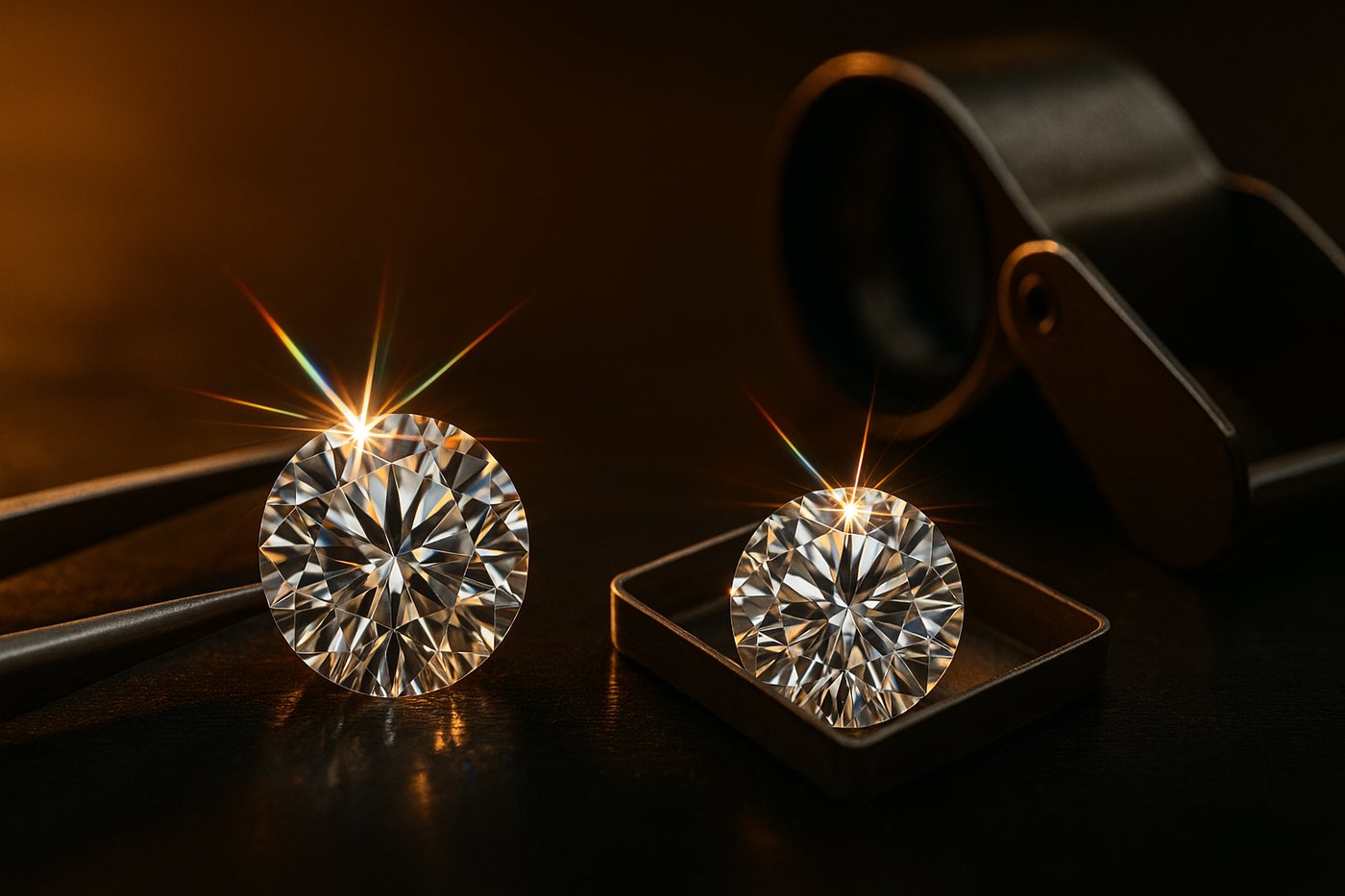
The natural vs lab-grown diamond question comes up in almost every solitaire consultation now, and most answers online are either static price-range guesses or thinly-disguised sales pitches for one option. Here's a straight comparison — price, certification, resale reality, and how to actually decide.
What's Actually Different (and What Isn't)
Natural and lab-grown diamonds are chemically and physically identical — both are pure carbon crystallised into the same structure. The only real difference is origin: one formed in the earth over billions of years, the other grown in a lab over weeks using high-pressure or vapour-deposition methods. Visually and to standard testing, they present the same brilliance and hardness. The difference that actually matters to buyers is everything downstream of that origin — price, scarcity, and resale.
Price Comparison: What You Actually Pay Per Carat
At Sun Sea Jewellers, a natural diamond in a common commercial grade (I colour, SI clarity) runs roughly ₹1.25–1.50 lakh per carat — smaller stones start lower, with entry sizes around 0.90ct available from about ₹85,000. Lab-grown diamonds run roughly ₹15,000–30,000 per carat across most qualities and sizes, a considerably flatter and more accessible range regardless of the specific grade. These are our actual price bands, not third-party market averages, but they still move with the day's rates and your exact stone choice — which is exactly why a static number is less useful than a live calculator. Our solitaire configurator prices both diamond types in real time rather than off a table like this one.
The Real Price Breakup: What You're Paying For
Whichever diamond type you choose, the total price on a finished solitaire piece breaks down into: gold weight and value, diamond value (driven by carat, cut, clarity, and shape), making charges, and GST charged as a flat 3% on the full total. For diamond jewellery specifically, our making charges run ₹1,200–1,500 per gram of gold, depending on design complexity and finish quality — ask any jeweller to show you this exact breakdown rather than accepting a single bottom-line number, it's the only way to actually compare two quotes fairly.
Certification: GIA vs IGI vs HRD, and Why It Matters
Never buy a diamond above a token size without independent certification — a jeweller's own in-house grading isn't the same thing.
- GIA (Gemological Institute of America) — the most globally recognised grading body, and carries the strongest resale/trust premium, particularly for natural diamonds.
- IGI (International Gemological Institute) — the dominant certifier specifically for lab-grown diamonds in India and globally, widely trusted and fast-growing alongside the lab-grown category itself.
- HRD (Hoge Raad voor Diamant) — a well-regarded European certification body, commonly seen alongside GIA and IGI in the Indian market.
For a natural diamond, GIA certification is generally worth prioritising if the price difference versus other labs is reasonable. For lab-grown, IGI certification is the standard to look for.
Resale Value: The Honest Picture
This is where the two diverge most, and where buyers most often get an overly rosy picture from sales conversations. Natural diamonds typically recover somewhere in the 40–60% range of original price on resale (occasionally higher for exceptional stones), while lab-grown diamonds typically recover meaningfully less — often in the 20–40% range, and sometimes close to negligible on the open resale market. This gap is driven largely by supply: lab-grown production capacity in India has scaled dramatically in the past few years, which keeps pushing lab-grown prices (and resale values) down over time.
The honest takeaway: don't buy either a natural or a lab-grown diamond as an investment. Buy natural if resale value and rarity matter to you; buy lab-grown if you want the same visual brilliance at a fraction of the cost and resale isn't a priority.
Which One Is Right for You?
- Choose natural if: resale value, rarity, and long-term heirloom status matter to you, and budget is flexible.
- Choose lab-grown if: you want a visually identical, certified diamond at a significantly lower price, and you're buying primarily for how it looks and feels to wear — not as a store of value.
- Either way: insist on independent certification (GIA for natural, IGI for lab-grown) and ask for the full price breakup before deciding.
A Quick Buyer's Cheat Sheet: The 4 Cs
- Carat — the diamond's weight, not its size on your finger; cut quality affects how large a stone looks for its carat weight.
- Cut — how well the diamond is proportioned and faceted; this is what actually drives sparkle, more than carat alone.
- Clarity — internal inclusions, graded on a scale from flawless down; most are invisible to the naked eye above a certain grade.
- Colour — graded from colourless downward; near-colourless grades are usually indistinguishable to the eye from truly colourless ones at a fraction of the price.
Same-Day Resizing and Complimentary Engraving on Ready Rings
Once you've chosen your solitaire, two things make the final step easier than most buyers expect. Ready rings can typically be resized the same day for a standard adjustment, so you're not left waiting on a piece you've already decided on. And engraving inside the band — a couple's names, initials, a short message, even a fingerprint or a small symbol — is complimentary, not an add-on charge. It's a small detail, but it's the kind of thing that turns a ring you bought into a ring that's actually yours.
Quick FAQ
Are lab-grown diamonds fake diamonds?
No — they're chemically and physically real diamonds, identical in composition and hardness to natural diamonds. The difference is origin, not authenticity.
Do lab-grown diamonds hold their value?
Less well than natural diamonds, generally. Expect meaningfully lower resale recovery on lab-grown stones — buy them for the look and value at purchase, not as an investment.
Which certification should I look for?
GIA for natural diamonds, IGI for lab-grown — both are internationally recognised and give you an independent, third-party grading you can trust.
Is engraving really free?
Yes — engraving on ready rings (names, initials, a short message, a symbol, or a fingerprint) is complimentary, included as part of the purchase rather than charged separately.
Buy the diamond that matches why you're actually buying it — resale value and rarity point one way, budget and brilliance point the other. Neither answer is wrong.
Visit Sun Sea Jewellers in Karol Bagh, Delhi
Sun Sea Jewellers has been in Karol Bagh, New Delhi since 1984. Our showroom is at 2659, Gurudwara Rd, Block 46, Beadonpura, Karol Bagh, New Delhi 110005, open Tuesday to Sunday, 11:30 am to 7:30 pm (closed Mondays). See hours, the map and directions on our Karol Bagh showroom page, or call +91 88608 66000 before you come.