NRI Bridal Jewellery Shopping in Delhi: Complete Guide
Sun Sea Jewellers, Karol Bagh, New Delhi · 12 August 2026
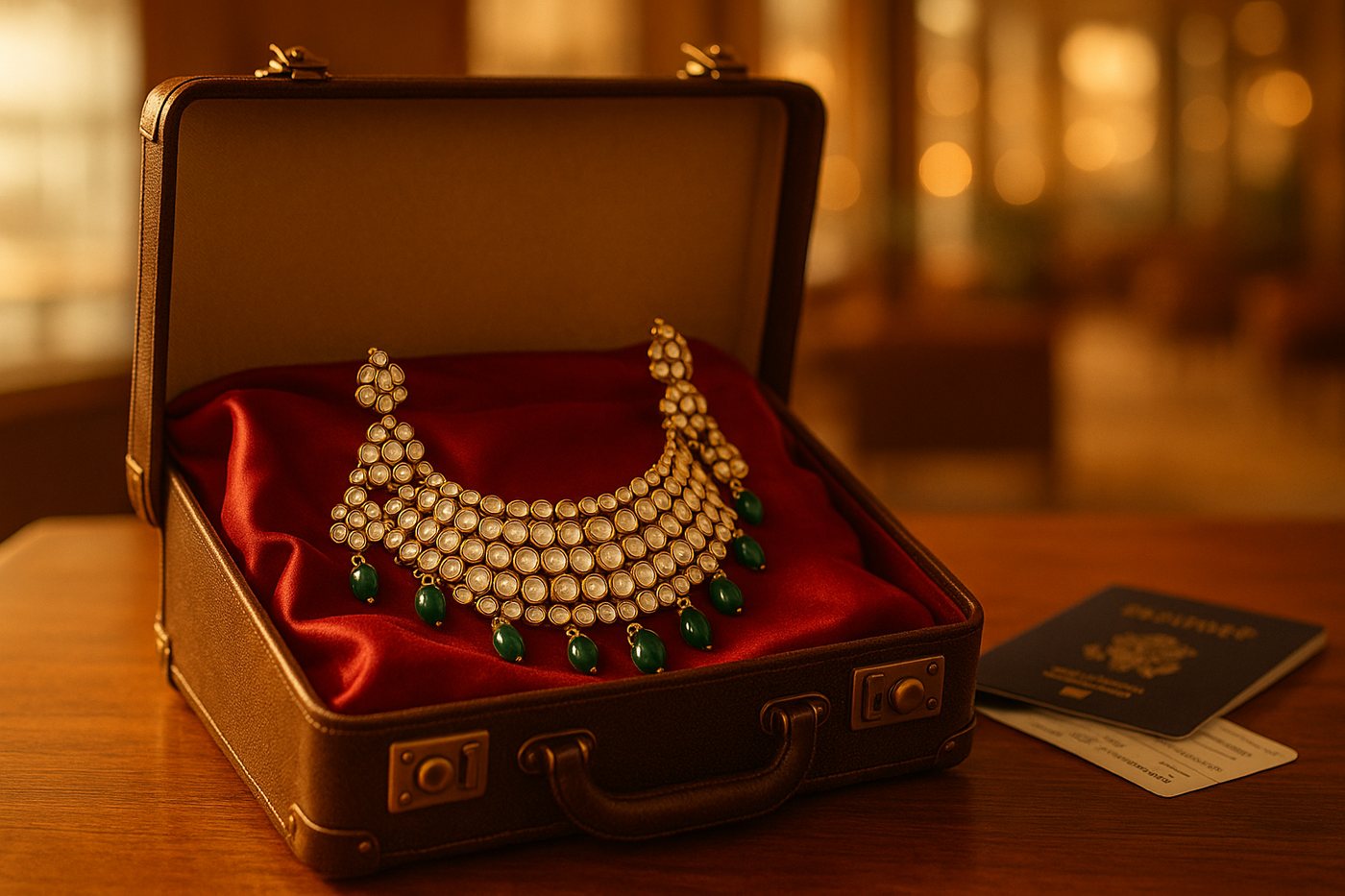
If you're an NRI planning a wedding — your own, or your child's — the jewellery shopping trip is often squeezed into a handful of days between flights, functions, and family commitments. Add jet lag and an unfamiliar market, and it's easy to either overpay or under-plan. This guide covers what actually matters: what you're legally allowed to carry home, how to verify what you're buying in under a minute, and how to use the days you have well.
Plan Before You Land: Shop Remotely, Decide On-Site
The single biggest time-saver for a short trip is deciding on style and budget before you arrive. A video consultation with a bridal specialist lets you narrow down Polki, Kundan, Jadau, or solitaire styles, discuss budget ranges, and even pre-select a few designs — so your in-store visit is about trying pieces on and finalising, not starting from zero. This matters more than most shopping guides mention, because it directly protects the two or three days you actually have free.
How Much Gold Can You Bring Home? Customs Duty Explained
Customs rules for carrying gold jewellery out of India (and into your destination country) matter as much as the price tag — an unexpectedly large duty bill at the airport can undo the savings of buying in India in the first place. As of the current baggage rules, the duty-free jewellery allowance for Indian passengers (including NRIs and OCI cardholders who have lived abroad for over a year) is weight-based: 40 grams for women and 20 grams for men, rather than a flat value cap. Gold coins and bars don't qualify for this allowance and are taxed on their full value regardless of weight.
These figures reflect current rules at the time of writing — customs regulations are revised periodically, so always confirm the latest allowance with the CBIC (Central Board of Indirect Taxes and Customs) or your airline before you travel, especially if you're carrying jewellery beyond personal wear pieces.
Polki vs Kundan vs Jadau vs Solitaire: Which Bridal Style Suits You
These terms get used loosely, so here's the actual distinction:
- Kundan — coloured glass or semi-precious stones set in gold foil. Lighter on the wallet, still visually rich, ideal for younger brides or additional trousseau pieces.
- Polki — uncut, natural diamonds set in gold. Costs meaningfully more than Kundan because the stones are real diamonds, not glass — the traditional choice for a statement bridal set.
- Jadau — a setting technique (not a stone type) used to mount both Kundan and Polki stones into gold without adhesive, by hand. You'll often see "Polki Jadau" or "Kundan Jadau" describing how a Polki or Kundan piece was actually made.
- Solitaire — a single certified diamond (natural or lab-grown) in a contemporary setting. Suits brides who want a piece they'll wear well beyond the wedding, and pairs naturally with fusion or western outfits alongside traditional ones.
There's no objectively "better" choice here — a heavily embroidered lehenga tends to call for the visual weight of Polki or Jadau, while a solitaire set works harder as an everyday piece afterward. If you're weighing this decision, our solitaire configurator lets you compare gold colour, diamond shape, and carat with real-time certified pricing before you commit.
Verifying What You're Buying, Even When You're Jet-Lagged
BIS hallmarking is India's mandatory gold purity certification, and every hallmarked piece carries a HUID (Hallmark Unique Identification) number — a 6-character alphanumeric code stamped on the piece. Any reputable jeweller can look up that HUID on the spot to confirm purity, so don't hesitate to ask, even if you're exhausted from travel and it feels easier to just trust the counter staff. A genuine jeweller will expect the question.
For diamonds, ask for independent certification — GIA, IGI, or HRD — rather than a jeweller's own in-house grading. This is exactly as important for a fast trip as a leisurely one; if anything, it matters more, since you won't have time to come back and query a discrepancy.
Resizing and Turnaround: What a Short Trip Actually Allows
Turnaround depends on how much resizing is needed, not a flat number — so ask specifically rather than assuming. At Sun Sea Jewellers, a standard resize (within about 2 sizes up or down) is usually same-day or next-day. A bigger size change typically takes around 5 working days, since more of the band needs rework. If a piece needs to be built fresh rather than resized — common with heavily set Polki or Kundan work where stones can't simply be moved — that's a different job entirely, usually 10 to 20 working days depending on design complexity. If your trip is under a week, ask which category your piece falls into before you commit, not after.
For ready solitaire rings specifically, resizing is often same-day. Engraving inside the band — names, initials, a short message, a symbol, even a fingerprint — is complimentary on these pieces too, which is a genuinely useful option for a short trip: you can personalise the ring without adding meaningful time to your visit.
Best Time to Shop: Wedding Season Crowds vs a Quieter Trip
India's wedding season (roughly October to February, plus auspicious dates through the year) means showrooms are busiest and consultation time is more rushed. If your trip dates are flexible at all, shopping slightly outside peak season gets you more unhurried attention from a specialist — genuinely useful when you're also trying to make efficient use of limited days in India.
Packing and Carrying Jewellery Home Safely
Carry bridal jewellery in your hand luggage, not checked baggage, and keep the original invoice and any certification documents with it — you may need to declare items at customs on both ends of your journey. Ask your jeweller about secure packaging designed for travel, and consider travel insurance that explicitly covers jewellery if the total value is significant; standard baggage insurance usually caps jewellery coverage well below its actual worth.
Understanding the Price: What You're Actually Paying For
A confusing part of jewellery shopping for many NRI buyers is that some sellers price loose diamonds and the gold setting as separate line items with different tax treatment, while others — including Sun Sea Jewellers — sell complete finished jewellery with GST charged as a flat 3% on the whole computed total (gold value, diamond value, making charges, and any side diamonds, all added first). Ask any jeweller to show you this exact breakdown before you decide — gold weight and purity, gold value, diamond value with carat and shape, making charges, GST, and total. If a seller can't produce that breakdown clearly, that's worth noting.
Quick FAQ
How much gold can an NRI bring into India duty-free?
Current rules set a weight-based allowance — 40g for women, 20g for men — for eligible passengers, separate from the general baggage allowance. Confirm the current figure with CBIC before travel, as rules are periodically revised.
Is Polki more expensive than Kundan?
Yes — Polki uses real uncut diamonds, while Kundan uses glass or semi-precious stones, so Polki carries a meaningfully higher price for a similar-looking piece.
Should I buy a solitaire or a traditional bridal set?
It depends on what you'll wear it with and how often — traditional Polki/Jadau sets suit heavily embroidered bridal outfits, while a solitaire tends to get worn more often afterward. Many brides do both: a traditional set for the wedding day, a solitaire for the everyday.
The best trip is the one where the decisions are already 80% made before you land — the showroom visit is for trying things on, not starting from scratch.
Visit Sun Sea Jewellers in Karol Bagh, Delhi
Sun Sea Jewellers has been in Karol Bagh, New Delhi since 1984. Our showroom is at 2659, Gurudwara Rd, Block 46, Beadonpura, Karol Bagh, New Delhi 110005, open Tuesday to Sunday, 11:30 am to 7:30 pm (closed Mondays). See hours, the map and directions on our Karol Bagh showroom page, or call +91 88608 66000 before you come.